A critical examination of the challenges and horizons shaping the nation’s basic education landscape
As the University of Batangas celebrates its 80th Founding Anniversary, our community gathered to address the urgent state of Basic Education in our country. On March 12, 2026, the Juan Y. Javier Culture and Arts Building hosted the second of the series of Founders Memorial Lecture (FML): The State of Basic Education in the Philippines. This event served as a critical platform to discuss the future of Filipino learners and the systemic reforms needed to stabilize the national learning landscape.


Clarion Call for Reform
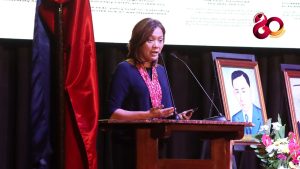
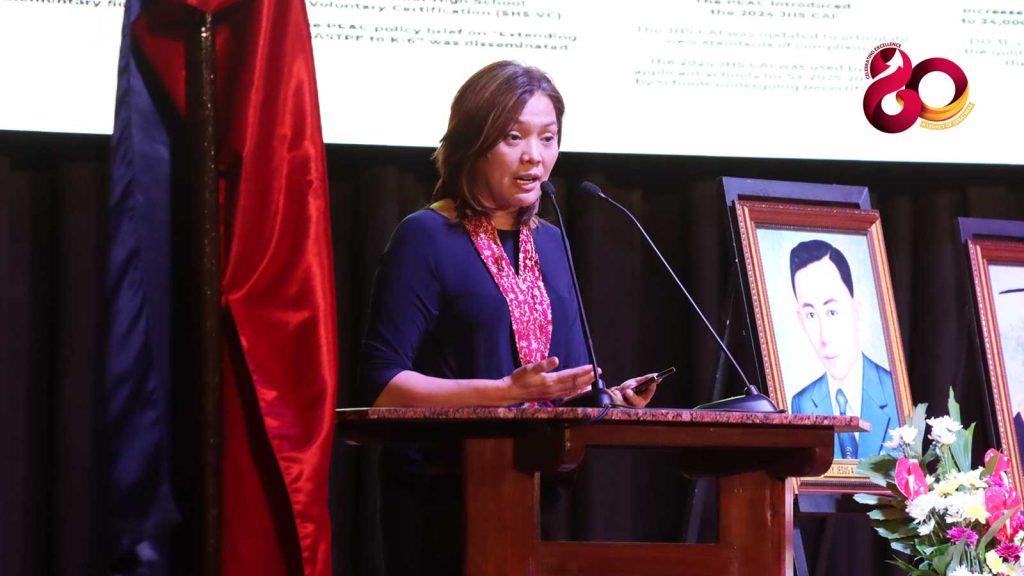
The keynote speaker was Dr. Rhodora Angela Fernandez Ferrer. As the Executive Director of the Private Education Assistance Committee (PEAC), she delivered a powerful message. Her address focused on the EDCOM II Final Report. Consequently, she laid bare a roadmap for what experts now call a “Decade of Necessary Reform.”
Dr. Ferrer began her lecture with a touch of nostalgia. She shared an anecdote about her previous visit to the University of Batangas. Years ago, she stood on our campus as part of the K-12 Curriculum launching roadshow. Returning now in 2026, she noted how our challenges have evolved.
Furthermore, she lauded the two-year extension of the Second Congressional Commission on Education (EDCOM II). She emphasized that significant work remains. Her message was clear: Let’s not have EDCOM III. We must fix the foundations immediately.
“One hundred years ago, in 1925, the Monroe survey warned that our children were not reading at grade level. In 1991, the first EDCOM declared the system ‘in a state of crisis.’ And yet, a century after Monroe, we find ourselves facing the same ghosts.” – EDCOM II
The lecture focused on the EDCOM II final report, “Turning Point: A Decade of Necessary Reform”. Dr. Ferrer reminded everyone: “What you are doing is not just for UB but for the nation.”
The statistics and realities shared were a sobering reminder of the basic foundational skills challenge in our country:
- The Grade 3 Literacy Gap: Only 1 in 3 learners in Grade 3 can read or count at grade level.
- The Proficiency Cliff: Student proficiency rates plummet from 30% in Grade 3 to a staggering 0.47% by Grade 12.
- The Learning Gap: By age 15, a Filipino student faces a 5.5-year learning gap relative to international standards.
The speaker pointed out that while the curriculum is often blamed, it is merely one factor in a complex web of systemic issues. One non-negotiable she highlighted: “We cannot not have contact hours for course content.” Effective learning requires time, engagement, and consistent interaction. This urgency is underscored by recent EDCOM II findings, which reveal that up to 30% of teaching days are lost (SY:2023-2024). When significant instructional time is repeatedly sacrificed to frequent school closures and the heavy burden of teachers’ non-teaching administrative tasks, even the most well-designed curriculum cannot succeed because educators simply lack the essential time to teach it.

Empowering Private Basic Education
Dr. Ferrer also discussed the vital role of the private sector. As the head of PEAC, she explained the history and significance of the Government Assistance to Students and Teachers in Private Education (GASTPE).
However, she noted a worrying trend in enrollment ratios. At the start of K-12 in 2016, the enrollment ratio for private and public Senior High Schools was 50:50. Today, that ratio has plummeted to 35:65.
While public schools receive full government support, funding for private schools remains stagnant. Therefore, she advocated for complementarity, not competition. She emphasized that the GASTPE and SHS Voucher Program empowers learners, teachers, parents, and schools. It ensures every Filipino child has options, regardless of the school’s banner.
The National Education Plan (2026-2035)
Looking forward, Dr. Ferrer shared the Key Priority Areas of the National Education Plan (2026-2035), the 10-year strategy designed to rescue the system:
- Early Childhood Education: Supporting the first 1,000 days and pre-school.
- Functional Literacy: Ensuring early learners can actually comprehend what they read.
- Graduate Readiness: Developing critical thinking, digital skills, and TVET alignment.
- Inclusive Learning: Ensuring no learner is left behind due to disability or circumstance.
- Tertiary Excellence: Equitable access to quality higher education.
- Governance Reform: Better resource allocation and transparency.
“Unless reforms are carried out with consistency and permanence, the same deficiencies will reappear.” – Paul Monroe (1925)
A Turning Point for UB and the Nation
Building on the insights from this Founders Memorial Lecture and as UB marks its 80th year, the University of Batangas reaffirms its commitment to being part of the solution. We are at a “Turning Point.” The challenges in Basic Education in the Philippines are vast, but as Dr. Ferrer reminded us, the report is not just a collection of statistics; it is a mandate for every stakeholder.
“The crisis is deep and longstanding, but it is neither inevitable nor irreversible.” – EDCOM II
Through collaboration, complementarity, and a relentless focus on foundational skills, we can ensure that the next hundred years of Philippine education are defined not by ghosts, but by excellence.

(L-R) Atty. Jesus V. Mayo, Chairman of the Board of Regents; Guest Lecturer – Dr. Rhodora Angela Fernandez Ferrer; and University President Lily Marlene J. Hernandez-Bohn during the 2nd Founders Memorial Lecture 2026